

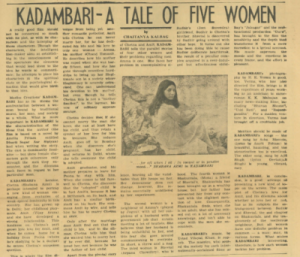
Kadambari- A Tale of five Women
Published date: 4th Dec 1975, Hi Newspaper
View PDFA really good film should not be concerned so much with its plot, as with its characters and the interplay of those characters. Though the characters, the intelligent filmmaker aims at establishing in the consciousness of the spectators the elements that would lead them to the idea he wants to communicate; he attempts to place his characters in the spiritual state or the psychological situation that would give birth to that idea.
Madhu Creations’ KADAMBARI has as its theme the confrontation between a woman bound by traditional mores, her man, and society as a whole. What is more Important in KADAMBARI is the characterisation of the Ideas that the author (the film is based on a novel by Amrita Pritam entitled Dharti Sagar Aur Sipiyan) had when writing the story. The cast is dominantly feminine – but these female characters gain coherence only through the men they encounter, and the dilemma each faces in regard to her particular man.
Kadambari’s heroine, Chetna (Shabana Azmi) is perhaps intended to portray a new kind of woman emerging from centuries of weak-spined femininity in this country. She has grown up in Delhi: her childhood playmate, Amit (Vijay Arora) and she have developed a strong relationship. This fondness on Chetna’s part grows into love for Amit, and when he comes home for a holiday from Poona (where he’s studying to be a doctor) he senses Chetna’s unspoken question.
This is where the film diverges from being yet another romantic potboiler. Amit tells Chetna he can never marry her, for he has dedicated his life and his love to only one woman – Amma, his mother (Chand Usmani). He describes how his mother was raped when she was barely fifteen, and how she has gone through countless hardships to bring up her illegitimate son in a society where illegitimacy is severely ostracised. One can understand his devotion to his mother. but even though he tells Chetna this is not a “mother fixation”, to the layman his vow of celibacy appears strange.
Chetna decides that if she cannot marry the man she loves, she can at least have his child, and thus retain a symbol of her love for him to treasure. She seduces Amit, goes off to Bombay when she discovers she’s pregnant: has her child, and returns to Delhi, where she tells everyone the child is adopted.
Amit graduates, and his mother prepares to leave for Poona to stay with him. When she comes to bid farewell to Chetna, she discovers that the “adopted” child is in fact Amit’s, because it has a birthmark on Its back, and Amit has a similar birth- mark on his back. She summons Amit by wire, and tells him he has to marry Chetna at once.
Only after the marriage does Amit find out that the child is his, and in the climax, Chetna tells him that she wanted him to marry her, if he ever did, because he loved her, not because he was the father of her child
Apart from the pivotal story of Chetna and Amit, KADAMBARI tells the parallel stories of four other women and their problems regarding men. Amma is one. She faces her problem in uncomplaining silence, braving all the vicissitudes that life heaps on her. Her demeanour does not change, however. She remains essentially embittered by her experiences.
The second woman is neighbour of Amma’s (played by Jugnu), with all her suspicions of a husband with a government job that entails meeting a lot of tourists. She believes that her husband is being unfaithful to her, and this fear she goes around communicating to everyone in short, a shrew and a nag The third woman is Sheetal Chowdhary), who is Sudhir’s (Jeet Surendra) girlfriend. Sudhir is Chetna’s brother. Sheetal is discovered by Sudhir going around with other boys. It turns out she has been doing this to cause Sudhir deliberate heartbreak. the result of a peculiar complex acquired in a overindulged but affectionless childhood. The fourth woman is Shakuntala, (Mona) a friend of Sheetal’s, Shakuntala has been brought up in a wealthy house, but her father has prevented her from any contact with the slightest mention of love. Consequently, Shakuntala finds, when she is an adult, that she has missed out on a lot of necessary knowledge, and isn’t able to cope with the men she encounters.
Kadambari’s music, by Ustad Vilayat Khan, is superb. The maestro, who scored the melody for such internationally acclaimed films as Ray’s “Jalsagar” and the multinational production “Guru”, has brought to the film the sensitivity and the depth that transforms it from a mere narration to a lyrical account His music expresses the moods and the emotions in every frame, and the effect is pleasant.
Kadambari’s photography by H. K. Verma is good, too. Verma, who has also directed the film, brings to it the experience of years working as an assistant to cameraman K. K. Mahajan on many news-making films, including “Bhuvan Shome”, “Uski Roti”, and “Rajanigandha”. For a maiden venture in direction, Verma has brought off a creditable job.
Mention should be made of Kadambari’s songs – the one sung by Asha Bhonsle, (lyrics by Amrit Pritam) is beautiful, haunting, and the picturisation too is excellent. The other song, sung by Ajit Singh (lyrics Geetanjali Singh) the young, vibrant, racy.
Kadambari, in conclusion, Is a good attempt at presenting a new kind of topic on the screen. The main Plot of – Chetna’s love for Amit, and his dilemma about whether to love her or not, has as its subplots the estrangement between Sudhir and Sheetal, the sad chapter on Shakuntala, and the tragicomedy of the vociferous neighbour, But all women have one definite problem in common – a man; man, in various forms. What makes Kadambari interesting, therefore, is how each woman tackles her problem.








s09sww
08pj6s
icp5ed
pilz82
57divk
mcb7ze
xp51ac
7s1zk5
Your point of view caught my eye and was very interesting. Thanks. I have a question for you. https://www.binance.bh/futures/ref?code=QCGZMHR6
2a7flx
Thanks for sharing. I read many of your blog posts, cool, your blog is very good.