

Interview- Mercedes-Benz bullish on India Market
[Reuters]
Published date: 1st Dec 1998
View PDF1 December 1998
Reuters News
English
(c) 1998 Reuters Limited
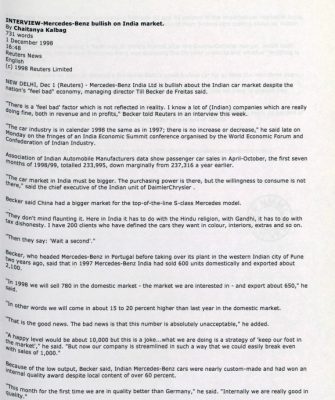
NEW DELHI, Dec 1 (Reuters) – Mercedes-Benz India Ltd is bullish about the Indian car market despite the nation’s “feel bad” economy, managing director Till Becker de Freitas said.
“There is a ‘feel bad” factor which is not reflected in reality. I know a lot of (Indian) companies which are really doing fine, both in revenue and in profits,” Becker told Reuters in an interview this week.
“The car industry is in calendar 1998 the same as in 1997; there is no increase or decrease,” he said late on Monday on the fringes of an India Economic Summit conference organised by the World Economic Forum and Confederation of Indian Industry.
Association of Indian Automobile Manufacturers data show passenger car sales in April-October, the first seven months of 1998/99, totalled 233,995, down marginally from 237,316 a year earlier.
The car market in India must be bigger. The purchasing power is there, but the willingness to consume is not there,” said the chief executive of the Indian unit of DaimlerChrysler .
Becker said China had a bigger market for the top-of-the-line S-class Mercedes model.
“They don’t mind flaunting it. Here in India it has to do with the Hindu religion, with Gandhi, it has to do with tax dishonesty. I have 200 clients who have defined the cars they want in colour, Interiors, extras and so on.
“Then they say: ‘Wait a second’.”
Becker, who headed Mercedes-Benz in Portugal before taking over its plant in the western Indian city of Pune two years ago, said that in 1997 Mercedes-Benz India had sold 600 units domestically and exported about 2,100.
“In 1998 we will sell 780 in the domestic market – the market we are interested in – and export about 650,” he said.
“In other words we will come in about 15 to 20 percent higher than last year in the domestic market.
That is the good news. The bad news is that this number is absolutely unacceptable,” he added.
“A happy level would be about 10,000 but this is a joke … what we are doing is a strategy of ‘keep our foot in the market’,” he said. “But now our company is streamlined in such a way that we could easily break even with sales of 1,000.”
Because of the low output, Becker said, Indian Mercedes-Benz cars were nearly custom-made and had won an Internal quality award despite local content of over 60 percent.
“This month for the first time we are in quality better than Germany,” he said. “Internally we are really good in quality.”
The trick had been to “marry” Indian and German component suppliers, Becker said. “This marriage which is fundamental makes it possible. And then you have to give them (the Indians) the chance to export to Germany.”
Becker said in India there was Intense competition among a host of carmakers for a share of the market for cars priced at up to 800,000 rupees ($18,845), but a vacuum in the “middle” segment of cars priced at between 800,000 and 2.2 million rupees.
Mercedes-Benz dominated the top of the price pyramid for luxury cars above the 2.2 million rupee level.
Becker said Mercedes-Benz also commanded between 80 and 85 percent of the imported-car market in India, and hoped to sell 220 imported cars to Indians in 1998, many of them S-class cars costing about six million rupees.
Asked whether he was taking a fresh look at India’s market after the DaimlerChrysler merger, which took effect last month, Becker said Mercedes-Benz was analysing the Chrysler products and whether “anything is viable for India”.
He said there were no plans to introduce Mercedes-Benz’s small A-class car for at least the next three years.
“We concentrate on the E-class from the Daimler side, and on the Chrysler side we have to analyse this market-wise.”
Under a cross-holding structure, India’s Tata Engineering and Locomotive Co Ltd (TELCO) holds 14 percent of Mercedes-Benz India and DaimlerChrysler holds a little over 10 percent of TELCO.
($1=42 rupees)
((New Delhi Newsroom +91-11-301-2024 Fax +91-301-4043, delhi.newsroom@reuters.com)).
(c) Reuters Limited 1998.


fswan1
pm81ag
iqloe4
htf1lg
3rraq3
55a2sr
p6gk3d
1u0de4
kwfn5r
22wmh3