

Jayme says no magic fix for Philippine debt
[Reuters]
Published date: 31st May 1988
View PDF31 May 1988
Reuters News
English
(c) 1988 Reuters Limited
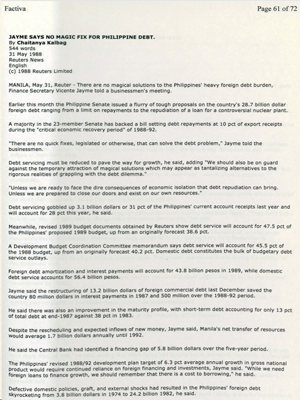
MANILA, May 31, Reuter – There are no magical solutions to the Philippines’ heavy foreign debt burden, Finance Secretary Vicente Jayme told a businessmen’s meeting.
Earlier this month the Philippine Senate issued a flurry of tough proposals on the country’s $28.7 billion dollar foreign debt ranging from a limit on repayments to the repudiation of a loan for a controversial nuclear plant.
A majority in the 23-member Senate has backed a bill setting debt repayments at 10 pct of export receipts during the “critical economic recovery period” of 1988-92.
“There are no quick fixes, legislated or otherwise, that can solve the debt problem,” Jayme told the businessmen.
Debt servicing must be reduced to pave the way for growth, he said, adding “We should also be on guard against the temporary attraction of magical solutions which may appear as tantalizing alternatives to the rigorous realities of grappling with the debt dilemma.”
“Unless we are ready to face the dire consequences of economic isolation that debt repudiation can bring. Unless we are prepared to close our doors and exist on our own resources.”
Debt servicing gobbled up $3.1 billion dollars or 31 pct of the Philippines’ current account receipts last year and will account for 28 pct this year, he said.
Meanwhile, revised 1989 budget documents obtained by Reuters show debt service will account for 47.5 pct of the Philippines’ proposed 1989 budget, up from an originally forecast 38.6 pct.
A Development Budget Coordination Committee memorandum says debt service will account for 45.5 pct of the 1988 budget, up from an originally forecast 40.2 pct. Domestic debt constitutes the bulk of budgetary debt service outlays.
Foreign debt amortization and interest payments will account for 43.8 billion pesos in 1989, while domestic debt service accounts for 56.4 billion pesos.
Jayme said the restructuring of 13.2 billion dollars of foreign commercial debt last December saved the country 80 million dollars in interest payments in 1987 and $500 million over the 1988-92 period.
He said there was also an improvement in the maturity profile, with short-term debt accounting for only 13 pct of total debt at end-1987 against 38 pct in 1983.
Despite the rescheduling and expected inflows of new money, Jayme said, Manila’s net transfer of resources would average 1.7 billion dollars annually until 1992.
He said the Central Bank had identified a financing gap of 5.8 billion dollars over the five-year period.
The Philippines’ revised 1988/92 development plan target of 6.3 pct average annual growth in gross national product would require continued reliance on foreign financing and investments, Jayme said. “While we need foreign loans to finance growth, we should remember that there is a cost to borrowing,” he said.
Defective domestic policies, graft, and external shocks had resulted in the Philippines’ foreign debt skyrocketing from 3.8 billion dollars in 1974 to 24.2 billion 1982, he said.
“It took us a decade to get into this problem. We need to recognise that even with intensive efforts on our part. It will take years before we fully put these problems to rest,” Jayme said.


**mitolyn official**
Mitolyn is a carefully developed, plant-based formula created to help support metabolic efficiency and encourage healthy, lasting weight management.