

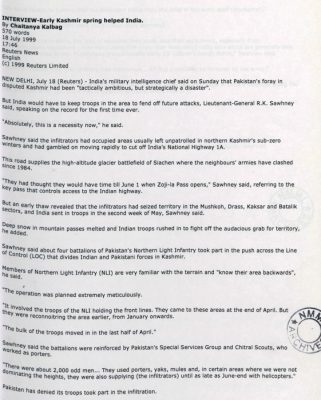
INTERVIEW-Early Kashmir spring helped India
[Reuters]
Published date: 18th Jul 1999
View PDF18 July 1999
Reuters News
English
(c) 1999 Reuters Limited
NEW DELHI, July 18 (Reuters) – India’s military intelligence chief said on Sunday that Pakistan’s foray in disputed Kashmir had been “tactically ambitious, but strategically a disaster”.
But India would have to keep troops in the area to fend off future attacks, Lieutenant-General R.K. Sawhney said, speaking on the record for the first time ever.
“Absolutely, this is a necessity now,” he said.
Sawhney said the infiltrators had occupied areas usually left unpatrolled in northern Kashmir’s sub-zero winters and had gambled on moving rapidly to cut off India’s National Highway 1A.
This road supplies the high-altitude glacier battlefield of Siachen where the neighbours’ armies have clashed since 1984.
“They had thought they would have time till June 1 when Zoji-la Pass opens,” Sawhney said, referring to the key pass that controls access to the Indian highway.
But an early thaw revealed that the infiltrators had seized territory in the Mushkoh, Drass, Kaksar and Batalik sectors, and India sent in troops in the second week of May, Sawhney said.
Deep snow in mountain passes melted and Indian troops rushed in to fight off the audacious grab for territory, he added.
Sawhney said about four battalions of Pakistan’s Northern Light Infantry took part in the push across the Line of Control (LOC) that divides Indian and Pakistani forces in Kashmir.
Members of Northern Light Infantry (NLI) are very familiar with the terrain and “know their area backwards”, he said.
“The operation was planned extremely meticulously.
“It involved the troops of the NLI holding the front lines. They came to these areas at the end of April. But they were reconnoitring the area earlier, from January onwards.
“The bulk of the troops moved in in the last half of April.”
Sawhney said the battalions were reinforced by Pakistan’s Special Services Group and Chitral Scouts, who worked as porters.
“There were about 2,000 odd men … They used porters, yaks, mules and, in certain areas where we were not dominating the heights, they were also supplying (the infiltrators) until as late as June-end with helicopters.”
Pakistan has denied its troops took part in the infiltration.
Pakistan’s army chief, General Pervez Musharraf, told the BBC on Friday his troops had carried out “aggressive patrolling” that took them across the LOC Into Indian Kashmir.
But Pakistani Prime Minister Nawaz Sharif denied on Friday the NLI had taken part in the capture of strategic heights.
Sawhney said the Indians had evidence showing “the plan was hatched at the Force Commander Northern Areas in Gilgit under the Pakistan Army’s 10th Corps.
“We have reason to believe that the directions came from the chief of the army staff (Musharraf).”
Pakistan says the intruders were mujahideen (holy warriors).
“The type of coordination, the type of weapons they used, plus their equipment, especially their communications equipment – they were using VHF (very high frequency) radio sets which are generally only used by the armed forces. Mujahideen groups usually carry CB (citizen’s band) radios,” Sawhney said.
“The coordination with their artillery was meticulous … All this underlines an invasion by the army.”
India’s army chief, General Ved Prakash Malik, told Reuters there had been gaps in India’s defences along the 740 km (460 mile) LOC but it was impossible to patrol every inch of it.
(c) Reuters Limited 1999.





k7k9yz
v2el67
ybn2t7
xr9s8h
hu4fdr
pzb9hu
y3x8a3
jws1ql
c3slgy
ebw5wl
qtyzc5
z7vlw6