Iran loses out in hostage deal
Published date: Business Standard, 22nd Jan 1981
View PDFFrom Chaitanya Kalbag
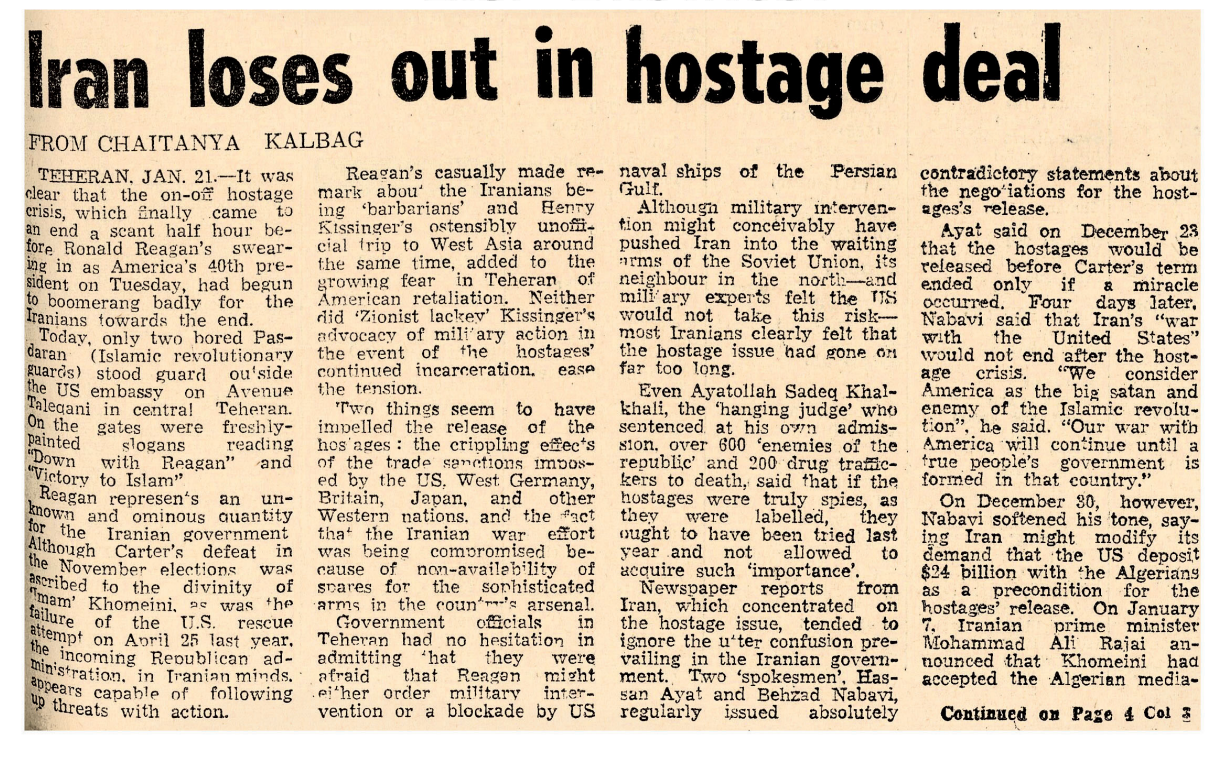
TEHERAN, JAN. 21—It was clear that the on-off hostage crisis, which finally came to an end a scant half hour before Ronald Reagan’s swearing in as America’s 40th president on Tuesday, had begun to boomerang badly for the Iranians towards the end.
Today, only two bored Pasdaran (Islamic Revolutionary Guards) stood guard outside the US embassy on Avenue Taleqani in central Teheran. On the gates were freshly-painted slogans reading: “Down with Reagan” and “Victory to Islam”.
Reagan represents an unknown and ominous quantity for the Iranian government. Although Carter’s defeat in the November elections was ascribed to the divinity of Imam Khomeini, it was the failure of the U.S. rescue attempt on April 25 last year, the incoming Republican administration, in Iranian minds, appears capable of following up threats with action.
Reagan’s casually made remark about the Iranians being “barbarians” and Henry Kissinger’s ostensibly unofficial trip to West Asia around the same time, added to the growing fear in Teheran of American retaliation. Neither did Zionist lobby Kissinger’s advocacy of military action in the event of the hostages’ continued incarceration, ease the tension.
Two things seem to have impelled the release of the hostages: the crippling effects of the trade sanctions imposed by the US, West Germany, Britain, Japan, and other Western nations, and the fact that the Iranian war effort was being compromised because of non-availability of spares for the sophisticated arms in the country’s arsenal.
Government officials in Teheran had no hesitation in admitting that they were afraid that Reagan might either order military intervention or a blockade by US naval ships of the Persian Gulf.
Although military intervention might conceivably have pushed Iran into the waiting arms of the Soviet Union, its neighbour in the north—and military experts felt the US would not take this risk—most Iranians clearly felt that the hostage issue had gone on far too long.
Even Ayatollah Sadeq Khalkhali, the “hanging judge” who sentenced at his own admission, over 600 enemies of the republic and 200 drug traffickers to death, said that if the hostages were truly spies, as they were labelled, they ought to have been tried last year and not allowed to acquire such importance.
Newspaper reports from Iran, which concentrated on the hostage issue, tended to ignore the utter confusion prevailing in the Iranian government. Two spokesmen, Hassan Ayat and Behzad Nabavi, regularly issued absolutely contradictory statements about the negotiations for the hostages’ release.
Ayat said on December 23 that the hostages would be released before Carter’s term ended only if a miracle occurred. Four days later, Nabavi said that Iran’s “war with the United States” would not end after the hostage crisis. “We consider America as the big satan and enemy of the Islamic revolution”, he said. “Our war with America will continue until a true people’s government is formed in that country.”
On December 30, however, Nabavi softened his tone, saying Iran might modify its demand that the US deposit $24 billion with the Algerians as a precondition for the hostages’ release. On January 7, Iranian prime minister Mohammad Ali Rajai announced that Khomeini had accepted the Algerian mediation.
The same day, without studying the US response to the Iranian demands, Ayat said that it was not acceptable. As late as on December 31, Ayatollah Yahya Noori, one of the militant mullahs leading Iran today, said that the hostages were definitely spies and should be tried.
But government officials appeared to have noticed the disclosure by Jack Anderson in the Washington Post in late December of what he claimed was a secret US-Soviet plan to carve Iran up into two parts, the US taking the south while the Soviets took the north.
Four Algerian mediators who played a vital role in the hostage release, and succeeded where men like the PLO’s Arafat, Pakistan’s Zia Ul Haq, Swiss and German diplomats and French lawyers had failed, were Algerian ambassador to Iran Abdel Karim Gheraieb, Algerian ambassador to the US Redha Malek, foreign minister Muhammad Seddik Ben Yahia, and governor of the Algerian Central Bank Mohammad Seghir Mostefai.
The hostages deal, if one were to go by the militancy of the Iranians, was a total defeat for them in terms of the financial settlement. In their demands, released on December 21, the Iranians asked for $9 billion in frozen Iranian funds in US banks, $15 billion in guarantees by the US to be deposited in Algerian banks, and 1.6 million troy ounces of Iranian gold with the Federal Reserve Bank in New York to be returned.
The US has instead agreed to deposit only $8 billion of frozen Iranian funds in an escrow account in London and to return the gold, which weighs 50 tonnes and is valued at $900 million.
Officials of Bank Markazi, the Iranian central bank, are of the opinion that this amount will be sufficient only to buy arms and supplies for the next six month’s. Nearly half the amount is owed to US banks against past loans, but the Iranians may renege on these payments. The country’s foreign exchange reserves had sunk as low as $1 billion, which is the monthly requirement for buying food supplies and spare parts for arms.
The lifting of trade sanctions imposed on Iran by Norway, West Germany, Britain and Japan should vastly ease the situation in Iran, whose economy was totally dependent on imports. Much of the supplies since the sanctions began were coming in from Dubai and Kuwait, with Turkey and the Soviet Union helping out too. But shortages had severely hit the Iranian people.
Iranian motorists, for example, are entitled to only 45 litres of petrol a month at 40 rials a litre (about Rs. 5) four times the pre-war price. Private cars are not allowed on the streets until 2 in the afternoon. Sugar, rice, milk, eggs and bread are in short supply, while meat costs as much as 750 rials (about Rs. 80) a kg.
Most imports have been banned anyway, with automobiles, tyres, and luxury items topping the list, but the shops in Teheran still display a large variety of imported goods, offered at as much as thrice their old prices.