Business Sees Coup Attempt As Warning to Aquino
[Reuters]
Published date: 31st Aug 1987
View PDF31 August 1987
Reuters News
English
(c) 1987 Reuters Limited
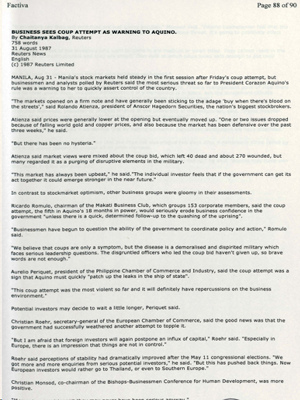
MANILA, Aug 31 – Manila’s stock markets held steady in the first session after Friday’s coup attempt, but businessmen and analysts polled by Reuters said the most serious threat so far to President Corazon Aquino’s rule was a warning to her to quickly assert control of the country.
“The markets opened on a firm note and have generally been sticking to the adage ‘buy when there’s blood on the streets”,” said Rolando Atienza, president of Anscor Hagedorn Securities, the nation’s biggest stockbrokers.
Atienza said prices were generally lower at the opening but eventually moved up. “One or two issues dropped because of falling world gold and copper prices, and also because the market has been defensive over the past three weeks,” he said.
“But there has been no hysteria.”
Atienza said market views were mixed about the coup bid, which left 40 dead and about 270 wounded, but many regarded it as a purging of disruptive elements in the military.
“This market has always been upbeat,” he said. “The individual investor feels that if the government can get its act together it could emerge stronger in the near future.”
In contrast to stock market optimism, other business groups were gloomy in their assessments.
Ricardo Romulo, chairman of the Makati Business Club, which groups 153 corporate members, said the coup attempt, the fifth in Aquino’s 18 months in power, would seriously erode business confidence in the government “unless there is a quick, determined follow-up to the quashing of the uprising”.
“Businessmen have begun to question the ability of the government to coordinate policy and action,” Romulo said.
“We believe that coups are only a symptom, but the disease is a demoralised and dispirited military which faces serious leadership questions. The disgruntled officers who led the coup bid haven’t given up, so brave words are not enough.”
Aurelio Periquet, president of the Philippine Chamber of Commerce and Industry, said the coup attempt was a sign that Aquino must quickly “patch up the leaks in the ship of state”.
“This coup attempt was the most violent so far and it will definitely have repercussions on the business environment.”
Potential investors may decide to wait a little longer, Periquet said.
Christian Roehr, secretary-general of the European Chamber of Commerce, said the good news was that the government had successfully weathered another attempt to topple it.
“But I am afraid that foreign investors will again postpone an influx of capital,” Roehr said. “Especially in Europe, there is an impression that things are not in control.”
Roehr said perceptions of stability had dramatically improved after the May 11 congressional elections. “We got more and more inquiries from serious potential investors,” he said. “But this has pushed back things. Now European investors would rather go to Thailand, or even to Southern Europe.”
Christian Monsod, co-chairman of the Bishops-Businessmen Conference for Human Development, was more positive.
“If investors want to wait they may never have been serious anyway.”
“If investors say they will wait they are just giving excuses,” Monsod said. “Filipino businessmen feel that the coup demonstrated government’s ability to deal with the most serious threat. It’s going to positively affect their psychology.”
Roehr said, “Most of the investors who want to come in are medium or small sized. They cannot react in the same way as multinationals and they are afraid. They look at which place looks safe enough to put their money.”
Romulo said “It takes a long time to gain business confidence.”
“Now it is being eroded by the perception of a lack of clear direction. From a management point of view there are no clear goals. True, the basic infrastructure of a democracy is in place, but the investment climate involves other things. We feel Friday’s violence was a prelude to another coup.”
Francisco Nemenzo, professor of political science at the University of the Philippines, said, “Which investor wants to put his money in a country that has a coup every other day?”
“We are fooling ourselves if we believe that by setting up formal democratic institutions we have stabilised.”
Nemenzo said it was no coincidence that the coup bid was staged two days after a nationwide strike called by left-wing labour leaders to protest an oil price increase.
“The military was just looking for a sign that Aquino’s popularity was fading,” he said. “Aquino may have won the battle, but the war goes on.”