

Should Reservations be Scrapped?
Published date: 16th-29th Mar 1981, Mixed Paper Article
View PDFThe question is being debated as never before
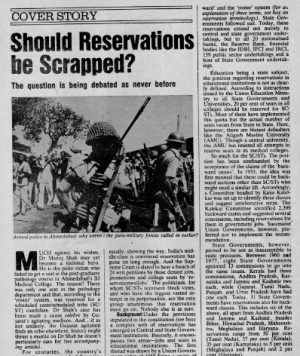
Much against his wishes, Dr Manoj Shah may yet become a national hero. He is the polio victim who failed to get a seat in the post-graduate pathology course in Ahmedabad’s BJ Medical College. The reason? There was only one seat in the pathology department and that, according to the ‘roster’ system, was reserved for a scheduled caste/scheduled tribe (SC/ ST) candidate. Dr Shah’s case has been made a cause celebre by Gujarat’s agitating medicos. And, if as not unlikely, the Gujarat agitation finds an echo elsewhere, history might thrust a mantle on Dr Shah he doesn’t particularly care for (see accoтраnying article).
For centuries, the country’s oppressive caste system had discriminated against the ‘untouchables’. Conscious of this, the founding fathers of modern India had enshrined certain clauses in the Constitution enjoining the state to discriminate in favour of them. Three decades later, this bias is being resented as never before. While Gujarat-Gandhi’s birthplace-is ironically, showing the way, India’s middleclass is convinced reservation has gone on long enough. And the Supreme Court is slated to hear a bunch of 24 writ petitions by those denied jobs, promotions and college seats by ‘reservationwallahs’ The politicians, for whom SC/STs represent block votes, and who have the biggest vested interest in its perpetuation, are the only group unanimous that reservation must go on. Nobody else is as sure.
Background: Under the provisions stipulated in the constitution (see box) a complex web of reservations has emerged in Central and State Government institutions. Basically, it encompasses two areas-jobs and seats in. educational institutions. The first thread was drawn by a Union Government order of 1950 fixing a quota of 22.5 per cent (15 per cent for SCs and 7.5 per cent for STs, roughly their percentage in the country’s population) for central government jobs filled on direct recuitment. Around this base grew up the corollaries: fee concessions, lower minimum standards, ‘interchangeability’, ‘carry for ward’ and the ‘roster’ system (for an explanation of these terms, see box оn reservation terminology). State Governments followed suit. Today, these reservations extend not merely to central and state government undertakings, but to all 20 nationalised banks, the Reserve Bank, financial bodies like the IDBI, IFCI and IRCI, 159 public sector undertakings and a host of State Government undertakings.
Education being a state subject, the position regarding reservations in educational institutions is not as clearly defined. According to instructions issued by the Union Education Ministry to all State Governments and Universities, 20 per cent of seats in all colleges should be reserved for SC/ STs. Most of them have implemented this quota but the actual number of seats varies from State to State. Here, however, there are blatant defaulters like the Aligarh Muslim University (AMU). Though a central university, the AMU has resisted all attempts to reserve seats in its medical colleges.
So much for the SC/STs. The position has been confounded by the acceptance of the claims of the ‘backward castes’. In 1953. the idea was first mooted that there could be backward sections other than SC/STs who might need a similar lift. Accordingly, a Committee headed by Kaka Kalelkar was set up to identify these classes and suggest ameliorative steps. The Kalekar Committee identified 2,399 backward castes and suggested several concessions, including reservations for them in government jobs. Successive Union Governments, however, preferred not to implement the recommendation.
State Governments, however, proved to be not as insusceptible to caste pressures. Between 1960 and 1977, eight State Governments apointed 13 commissions to go into the same issues. Kerala had three commissions, Andhra Pradesh, Karnataka and Jammu and Kashmir two each, while Gujarat, Tamil Nadu, Punjab, and Uttar Pradesh have had one each. Today, 11 State Governments have reservations also for backward classes. This includes six of the above, all apart from Andhra Pradesh and Jammu and Kashmir, besides Bihar, Himachal Pradesh, Maharashtra, Meghalaya and Haryana. Reservations range from 50 per cent (Tamil Nadu), 37 per cent (Kerala), 35 per cent (Karnataka) to 5 per cent (Meghalaya and Punjab) and 2 per cent (Haryana).
Upper-caste resentment against such wide-ranging discrimination has always simmered. Wherever provocation has been too blatant, it has burst violently open. As in Bihar, in 1978, when Karpoori Thakur, the backward’s champion, rammed through reservation of 20 per cent for backwards. The result was a caste war between Bihar’s ‘forwards’ and ‘backwards’ which carried on throughout 1978 and claimed over 200 lives. A more recent example, though not as murderous, is Tamil Nadu where upper castes are up in arms against MGR’s February 1980 decision to raise reservations for backwards from 31 per cent to the all-India high of 50 percent (see accompanying acticle).
Today, resentment at varying levels of intensity can be found in all Central Government organisations and in all the States where reservations exist for both backwards and SC/STs. Leading the agitation are those whose professional chances are affected: Central and State Government employees, bank employees, railway employees, and students in technical institutions and medical colleges. Their organised and vocal resentment has created a controversy on the entire issue of reservation.
Many feel reservations should go altogether. Says TD Murthy, 30. an upper caste who was denied a medical college seat and who now works as a company executive in Bangalore: “There should be equal opportunities for all.” Gujarat’s medicos want abolition of reservation in specialised levels like the post-graduate (P-G) courses in colleges.
Jurists and politicians, however, disagree. Ruled former Chief Justice AN Ray in a judgment on a reservation case: “Equality of opportunity for unequals can only mean aggravation of inequality… the quality and concept of equality is that if persons were dissimilarly placed they cannot be made equal by having the same treatment.” Says Arvind Netam, tribal Congress (I) MP and former Central Minister: “It is not only sensible but also necessary to continue reservations. Can a community, neglected for centuries, be uplifted in ten or even thirty years?”
HOWEVER, it is not reservation per se that is being challenged—even Gujarat’s medicos have nothing against reservations at the undergraduate level. What is attracting more ire are all the corollaries. Gujarat’s medicos are more upset at the advatages the SC/STs gain in scaling the professional rungs after they complete their MD. Government employees resent the reservations at the recruitment stage, but they positively fume at the rapid promotions the SC/STs get, turning subordinates into bosses. Does reservation in apointments and posts as promised by Article 16(4), they ask, also mean preferential treatment in promotion?
Besides, they argue, are not these favours towards those implicitly not as competent impairing efficiency? Dosen’t Article 335 sav clearly that the claims of the SC/ST’s “shall be taken into consideration, consistently with the maintenance of efficiency of administration”? If efficiency is dispensable, why not reserve crucial jobs like airline pilots for them? Medicos take heart from a Union Health Ministry review which concluded led that P-G education could not be equated with undergraduate (U-G) medical courses because the former was a specialised training and it wouldn’t be proper to lower the standards of P-G courses by reservation of seats or relaxation of minimum marks for admission. Their case is also strengthened by a Madhya Pradesh High Court decision last November which quashed a State Government order waiving minimum qualifying marks for filling vacant seats reserved for SC/STs in the State’s five medical colleges.
However, there is a strong body of opinion against these arguments also. Notes Shishir Kumar, commissioner for SC/STs, in his latest report: “there is no significant evidence to indicate that the efficiency in the administration has, in any way, been impaired by the SC/STs in services.” Said Chief Justice Gajendragadkar in a judgment: “Reservations may theoretically and conceivably mean some impairment but the risk involved must always be borne in mind when any State sets about making (such a) provision. Argues Bhola Paswan Shastri, 66, Congress (U) MP and head of the commission for SC/STs: “There should be no cut-off level in educational reservation. Such is the prejudice and discrimination, if there is no reservation they will. disqualify even a qualified candidate” Says Bal Naik, 30, an SC employed as a trainee in a Bangalore public sector corporation: “With so much of nepotism in the country, reservations neutralise the effect.”
Anti-reservationists disagree. They say nepotism is inbuilt even in a caste-based reservation system. Its benefits have only gone to the better-off castes among the backwards. Even Ramavdesh Singh, an aggressive leader of Bihar’s backwards, admits that the fruits of Karpoori Thakur’s reservations have been usurped by three landed and educated castes-Yadavs, Kurmis and Koeris. Tamil Nadu’s upper castes charge that nine backward classes have monopolised reserved jobs and college seats in the state (see accompanying article).
Gujarat’s medicos furnish lists showing that 35 out of 57 SC/STs who have joined the PG courses in the last five years came from affluent families-one is the son of a former Speaker, another of a Janata Party MP, and the third of a Collector. Shouldn’t they argue, there be some economic criteria? And besides, they conclude, aren’t these concessions to castes intensifying the grip of that invidious system”
THIS criticism of the reservation system finds many more acceptors. Surely, a combination of caste origin plus an economic cut-off point should be the best criterion for determining backwardness. Even Kaka Kalelkar had come to the conclusion towards the end of his two-year long investigation that a principle other than caste would have been a better criterion.
The sole exception was Budho Priya Maurya, 55, Rajya Sabha MP, former Minister under Mrs Gandhi. who is now an Independent MP. An SC, Maurya regrets that not a single political party in the country has the moral courage to oppose the reservation policy which is not benefitting the SC/STs in any way-Maurya believes that Article 15 (4) which enjoins the State to make special provisions for “the advancement of any socially and educationally backward classes” should be amended to include economically backward. Maurya, who has denied all reservation facilities for his own’ children, warns, “only Gujarat is burning at the moment, soon the entire country will be burning if reservation only on the basis of caste is not done away with. Parliamentary democracy and the politics of caste cannot go hand-in-hand. India will have to say goodbye to one.”
HOWEVER, all politicians interviewed by NEW DELHI, with one exception, were unanimous that caste must be the deciding factor. They pointed out that it was not without reason that both, the two central commissions—Kaka Kalelkar and BP Mandal—and all the 13 state-level commissions recommended unanimously to that effect. Said BP Shastri: “The social factor cannot be ignored. An illiterate Brahmin can open a hotel, an illiterate SC cannot. A SC had started a dhaba (roadside restaurant) in a Bihar village. He had to shut it down when it became known he was an SC.
K Subramaniam, Lohiaite ideologue and member of the backward classes commission, agrees: “Article 340 puts ‘socially and educationally’ (classes) together and deliberately so.
One community may be politely powerful and economically well-off yet may be backward. In 1974, there was not one jat gazetted officer in Haryana.” Charged Arvind Netam: “At heart, the upper castes don’t want the others to come up. How else do you explain all the writs filed in the courts?” Madhavsinh Solanki, Makwana and Jagjivan Ram all argued.
Maurya’s is bound to remain a lone voice. For politicians of all hues, cast-votes are too sensitive a vote bank to be tampered with. As GK Reddy noted political columnist of The Hindu wrote recently: “In no other society can politicians get away with such cynical behaviour by pondering to the whims and fancies of sectarian interests which are able to influence their electoral fortunes.”
“Karpoori Thakur has. perhaps, been the most cynical of all. In 1978. Bhola Paswan Shastri: ‘There is too much prejudice’
he thrust reservations on Bihar on the eve of three crucial elections. And what did Bihar’s backwards gain? Said Thakur Prasad Singh, Industries Minister in the Thakur Ministry: “Bihar’s backwards are left with claims to 2600 jobs annually, after the unreserved seats and the SC/ST quota is taken out. For a population of over six crores that’s peanuts. Was it worth setting Bihar aflame for so few jobs?”
India’s Christians of SC origin suffer from another sort of discrimination: thanks to a Constitutionai amendment which enshrined in Article 341 that “no person who professes a religion different from the Hindu or Sikh religion shall be deemed to a member of a scheduled state.” Christian leaders have been crying themselves hoarse that Christians of SC orgin suffer from the same handicaps as Hindus or Sikhs. Anjiah’s government is the only one which ordered last year that Christians be treated as backward classes. Others, including the Central Government, have paid no heed. No block votes you see. Will we see the end of the politics of caste soon?
That does not seem likely: not if the Government accepts the findings of the Mandal Commission. This Commission, headed by Bindeshwari Prasad Mandal, a former Chief Minister of Bihar, was set up by the Janata Government. It submitted its report on 31 December 1980. Its terms of reference had not asked it to prepare any list of backward castes. But it has gone and done just that.
Moreover, its recommendations, if accepted, will only fuel the flames now flaring. Even though its recommendations have yet to be made public, NEW DELHI has learnt that three of its most important recommendations are:
- There should be 27 per cent reservation for backward classes. This is on the basis of their findings that roughly 54 per cent of the country’s population are backward castes.
- Reservations should be extended to the private sector and the judiciary. Presently, there is none in the former and only at the lower levels in the latter.
- There should be statutory enforcement of the list. Now, the Centre cannot enforce the list on the States. Further, there should be a statutory obligation on the part of the States to enforce reservation. Now, some states don’t bother because Articles 15 (4) and 16 (4) are enabling, not obigatory, clauses.
That’s an explosive package-ask India’s 24 per cent “Forwards”
—Ajay Kumar with Vivek Sengupta in Delhi, Raj Chengappa in Bangalore and Arun Ranjan in Patna/Interviews by Vivek Sengupta and Mehru Jaffer.
JAGJIVAN RAM
‘Harijans Must Fight it Out’
JAGJIVAN Ram, 73, regards himself, and rightly so, as more of a national leader than just a leader of Harijans. But the Gujarat imbroglio has clearly touched a raw nerve in the septuagenarian leader. Dubbing the events in that state as “genocide” against the Harijans, Ram made an emotional speech defending reservations in Parliament on 5 March. Next day, “Babujee” granted a long, exclusive interview to NEW DELHI’S Vivek Sengupta, just before he left for a tour of Gujarat. Excerpts:
Q: Is it sensible to continue with reservations even three decades after they were introduced?
A: Is it sensible to ask this without fully appreciating the circumstances in which reservation was provided and without assessing whether there has been any material change in the circumstances which existed when the Constitution was adopted? Have the various disabilities the scheduled castes and scheduled tribes were suffering, disappeared? Any sensible person will agree that most of the disabilities are still there. So long as caste is the determining factor of an individual’s status and station in Indian society, reservations must continue.
Shouldn’t economic backwardness rather than caste be the basis for reservation?
No, it should not. Because economic progress is not the determining factor of the status of an individual in our society. A Brahmin working as a cook for a millionaire in Delhi may be illiterate but he considers himself superior to the man he works for if he is a non-Brahmin. A Brahmin will never salute a non-Brahmin, even though the latter may be much better off. But a Brahmin constable will positively salute a Yadava sub-inspector.
Should there be reservations in the specialised stages of education as in post-graduate courses in medicine?
So what if the scheduled castes are admitted to such courses? Is anyone who does not pass the examination given a certificate? I don’t seek any relaxation on the passing of examinations. Where then does the question of competence or incompetence come up? Where is the harm if you let the son of a scheduled caste railway driver, who is a first generation medical student, study post-graduate medicine along with an upper caste boy who is a fourth generation medical student, if both qualify?
Will the tensions generated in Gujarat escalate in the future?
It will all depend on how the Government tackles the situation. It began in a small way and flared up because of the Government’s failure to tackle it. The basic question is that they either protect the Constitution or they do not. As it stands, one doesn’t even know what happened in certain areas in Gujarat. Even in Ahmedabad, my workers couldn’t visit many areas due to curfew. Hiralal Parmar Congress(I) MP, had his entire property burnt. He was given public notice three days before this happened. His family told the police and the collector but even then they burnt down everything.
But what is happening in Gujarat has happened on an all India basis Belchhi, Pipra, and what have you. Harijans have been massacred everywhere by our own co-religionists. The only redeeming factor is that even after all this, the people in those villages and also in Gujarat have not lost courage.
Twenty young men from Gujarat- professors, advocates, lawyers-came to me and said that they would fight even if they have to die. But our numbers are so small, nowhere more than 18 per cent. Militancy will mean that our men will die fighting. Unless good sense prevails on the caste Hindus and they allow Harijans their rights and an equitable share in the national wealth, the only alternative (for our people) is to stand up and fight.
What the Constitution says
The Constitutional position regarding reservations is guided by three Articles. Among these, Article 46, under the Directive Principles, is the key one. It states: “The State shall promote with special care the educational and economic interests of the weaker sections of the people, and, in particular, of the Scheduled Castes and the Scheduled Tribes, and shall protect them from social injustice and all forms of exploitation.” Article 16(4) of the Fundamental Rights and Article 335 provide the means for implementing this obligation. Article 16(4) allows discrimination in favour of any back ward class citizen by reserving places in appointments and Article 335 makes it mandatory for the State to take into consideration the claims of SC/STs cons tent with the maintenance of efficiency.
What is noteworthy about these provisions is that there is no time limit placed on them. If, in spite of that, the feeling commonly persists that these reservations were meant to expire after 30 years, the reason is that this stipulation was there but it was for reservation of seats in the Lok Sabha and State Vidhan Sabhas. These provisions-contained in Articles 330, 332 and 334-were to expire on 26 January, 1980. They were extended for another 10 years on 25 January, 1980. Currently, a total of 119 Lok Sabha constituencies (out of 542) are reserved for SC/STs
For the novice, the precise terminology within which the reservation issue is debated may sound like a babel of all the foreign tongues. To help him, here is a brief lexicon of reservation terminology:
SC/ST: Scheduled castes and scheduled tribes.
Backward classes: As defined by the Supreme Court, this refers to all classes which are socially and. economically backward, including the SCs/STs. As defined by the backward classes commissions, it refers to the castes between the SC/ST and the upper castes.
Backwards: In the Hindi belt and the southern states which have reservations for them the term is used in the same sense as the second definition above. In many other areas, the term is used as understood by the Supreme Court.
Roster: System by which a numerically fixed appointment, promotion or seat in college is given to a reserved candidate. For instance, the Railways has a 40-point roster system. In a cycle of 40 vacancies, Nos 1, 8, 14. 22, 28, and 36 are reserved for SCs and Nos 4, 19, and 31 for STs.
Carry forward: System by which reserved vacancies not filled are added on to the next year’s quota.
Interchangeability: System by which if there aren’t SC candidates to fill up their quota or enough ST candidates to fill up theirs, they can interchange and take each others’ quota.





https://shorturl.fm/2zd7v
flet.ai – The Ultimate AI Tools!
[5793]PH357: Best Online Casino & Slots in the Philippines. Quick PH357 Login, Register, and App Download to Win Big Today! Join PH357, the Philippines’ top online casino. Secure PH357 casino login, fast ph357 register & ph357 app download. Play ph357 slot games and win big today! visit: ph357
[3295]Kingjl Login & Register: Top Philippines Online Casino, Kingjl Slot & App Download Experience the best at Kingjl, the #1 Philippines online casino! Complete your Kingjl login or Kingjl register to play premium Kingjl slot games. Enjoy secure gaming and get the Kingjl app download for big wins on the go! visit: kingjl
[6077]Boss778 Philippines: Top Slot Games, Secure Login, & Easy Register. Download the App and Access Link Alternatif for the Best Online Casino Experience. Experience the ultimate online casino at Boss778 Philippines. Enjoy top boss778 slot games, secure boss778 login, and easy boss778 register. Access the boss778 download app and link alternatif now! visit: boss778
[8534]Jadesportsbet Official Site: Secure Login, Easy Register, and App Download for the Best Slots and Sports Betting in the Philippines. Experience the best slots and sports betting at the Jadesportsbet official site. Secure your jadesportsbet login, complete a fast jadesportsbet register, and get the jadesportsbet app download for premium gaming in the Philippines. Play jadesportsbet slots and win today! visit: jadesportsbet
[5035]fb777 Login & Register: Top Philippines Online Casino, App Download & Premium Slots Join fb777, the top Philippines online casino! Quick fb777 login & fb777 register for premium fb777 slot games. Secure fb777 app download & fb777 casino login. Start winning today! visit: fb777
[88]WinPH5 Online Casino: The Philippines’ Top Choice for Slots. Easy winph5 login, register, and winph5 app download for an elite gaming experience. Join WinPH5 Online Casino, the Philippines’ top choice for winph5 slots. Fast winph5 login, easy winph5 register, and winph5 app download for an elite gaming experience. visit: winph5
[7002]Tongitstok Online Casino: Easy Login, Register & App Download for the Best Slot Games in the Philippines. Join Tongitstok Online Casino, the Philippines’ premier destination for gaming. Enjoy seamless tongitstok login, quick tongitstok register, and the tongitstok app download for the best tongitstok slot games. Experience secure, high-payout online casino action and start winning today! visit: tongitstok
[780]J777: Best Slot Online & Casino in the Philippines. Secure J777 Login, Register, and Official J777 App Download Link. Experience the best slot online and casino in the PH at J777. Secure J777 login, quick register, and official J777 app download link. Visit the J777 casino link now! visit: j777
[7697]Experience the best online casino in the Philippines at 77ph1. Login or register now to play 77ph1 slots and live casino games. Secure 77ph1 app download available for the ultimate mobile gaming experience. Join 77ph1, the premier online casino in the Philippines. Quick 77ph1 login and register to play 77ph1 slots and live casino. Secure 77ph1 app download available! visit: 77ph1
[1462]PHGolden Casino Philippines: Easy Login, Register & App Download for Top Slots Experience PHGolden Casino Philippines! Enjoy easy phgolden login, fast phgolden register, and phgolden app download. Play top phgolden slots and win big today. visit: phgolden
[7014]cc7 Casino Online Philippines: Fast cc7 Login, Register & App Download for the Best cc7 Slots. Experience cc7 Casino Online Philippines! Get the best cc7 slots, fast cc7 login, easy cc7 register, and official cc7 app download. Join the PH’s top casino now! visit: cc7
Become our partner and turn referrals into revenue—join now!
Boost your profits with our affiliate program—apply today!
Promote our brand, reap the rewards—apply to our affiliate program today!
Refer friends, collect commissions—sign up now!
Share your link and rake in rewards—join our affiliate team!
zsz3z1
Start profiting from your network—sign up today!
I don’t think the title of your article matches the content lol. Just kidding, mainly because I had some doubts after reading the article.
**back biome**
Backbiome is a naturally crafted, research-backed daily supplement formulated to gently relieve back tension and soothe sciatic discomfort.
NerveCalm is a high-quality nutritional supplement crafted to promote nerve wellness, ease chronic discomfort, and boost everyday vitality.
Boostaro is a purpose-built wellness formula created for men who want to strengthen vitality, confidence, and everyday performance.
HeroUP is a premium mens wellness formula designed to support sustained energy, physical stamina, and everyday confidence.
ProDentim is a distinctive oral-care formula that pairs targeted probiotics with plant-based ingredients to encourage strong teeth, comfortable gums, and reliably fresh breath.
Mitolyn is a carefully developed, plant-based formula created to help support metabolic efficiency and encourage healthy, lasting weight management.
PurDentix is a revolutionary oral health supplement designed to support strong teeth and healthy gums. It tackles a wide range of dental concerns
AquaSculpt is a high-quality metabolic support supplement created to help the body utilize fat more efficiently while maintaining steady, reliable energy levels throughout the day.
Gluco6 is a natural, plant-based supplement designed to help maintain healthy blood sugar levels.
Maintaining prostate health is crucial for men’s overall wellness, especially as they grow older. Conditions like reduced urine flow, interrupted sleep
Arialief is a carefully developed dietary supplement designed to naturally support individuals dealing with sciatic nerve discomfort while promoting overall nerve wellness.
InsuLeaf is a high-quality, naturally formulated supplement created to help maintain balanced blood glucose, support metabolic health, and boost overall vitality.
Manergy is an advanced male vitality supplement created to help support healthy testosterone levels
ProstAfense is a premium, doctor-crafted supplement formulated to maintain optimal prostate function, enhance urinary performance, and support overall male wellness.
NerveGenics is a naturally formulated nerve-health supplement created to promote nerve comfort, cellular energy support, antioxidant defense
Nitric Boost Ultra is a daily wellness formula designed to enhance vitality and help support all-around performance.
Kerassentials is an entirely natural blend crafted with 4 potent core oils and enriched by 9 complementary oils and vital minerals.
Prostadine concerns can disrupt everyday rhythm with steady discomfort, fueling frustration and a constant hunt for dependable relief.
Visium Pro is an advanced vision support formula created to help maintain eye health, sharpen visual performance, and provide daily support against modern challenges such as screen exposure and visual fatigue.
ViriFlow is a dietary supplement formulated to help maintain prostate, bladder, and male reproductive health. Its blend of plant-based ingredients is designed to support urinary comfort and overall wellness as men age.
I don’t think the title of your article matches the content lol. Just kidding, mainly because I had some doubts after reading the article.
Share your unique link and cash in—join now!