

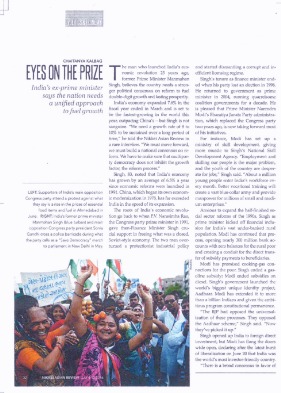
Eyes on the Prize
Published date: Nikkei Asian Review, 28th June 2016
View PDFIndia’s ex-prime minister says the nation needs a unified approach to fuel growth
Chaitanya Kalbag
The man who launched India’s economic revolution 25 years ago, former Prime Minister Manmohan Singh, believes the country needs a stronger political consensus on reform to fuel double-digit growth and lasting prosperity.
India’s economy expanded 7.6% in the fiscal year ended in March and is set to be the fastest-growing in the world this year, outpacing China’s-but Singh is not sanguine. “We need a growth rate of 8 to 10% to be sustained over a long period of time,” he told the Nikkei Asian Review in a rare interview. “We must move forward, we must build a national consensus on reform. We have to make sure that multiparty democracy does not inhibit the growth factor, the reform process.”
Singh, 83, noted that India’s economy has grown by an average of 65% a year since economic reforms were launched in 1991. China, which began its own economic modernization in 1978, has far exceeded India in the speed of in expansion.
The roots of India’s economic revolution go back to when P.V. Narasimha Rao, the Congress party prime minister in 1991, gave then-Finance Minister Singh crucial support in freeing what was a closed Soviet-style economy. The two men overturned a protectionist industrial policy and started dismantling a corrupt and inefficient licensing regime.
Singh’s tenure as finance minister ended when his party lost an election in 1996. He returned to government as prime minister in 2004, running quarrelsome coalition governments for a decade. He is pleased that Prime Minister Narendra Modi’s Bharatiya Janata Party administration, which replaced the Congress party two years ago, is now taking forward most of his initiatives.
For instance, Modi has set up a ministry of skill development, giving more muscle to Singh’s National Skill Development Agency. “Employment and skilling our people is the major problem, and the youth of the country are desperate for jobs, Singh said. “About a million young people enter India’s workforce every month. Better vocational training will. create a vast blue-collar army and provide manpower for millions of small and medium enterprises”.
Anxious to expand the half-finished social sector reforms of the 1990s. Singh as prime minister kicked off financial inclusion for India’s vast under-banked rural population. Modi has continued that process opening nearly 300 million bank accounts with zero balances for the rural poor and creating a conduit for the direct transfer of subsidy payments to beneficiaries.
Modi has promised cooking-gas connections for the poor. Singh ended a gasoline subsidy, Modi ended subsidies on diesel. Singh’s government launched the world’s biggest unique identity project, Aadhaar. Modi has extended it to more than a billion Indiana and giver the ambitious program constitutional permanence.
“The BJP had opposed the universalization of these processes. They opposed the Aadhaar scheme,” Singh said. “Now they’ve picked it up.”
Singh opened up India to foreign direct investment, but Modi has flung the doors wide open, declaring after the latest burst of liberalization on June 20 that India was the world’s most investor-friendly country. “There is a broad consensus in favor of what we started doing in 1991,” Singh said. sipping tea in his bungalow in New Delhi’s tree-lined Lutyens enclave. “At that time, there was a lot of opposition both from the IP as well as the left. But subsequent events have shown that when the time came, very few parties, very few governments wanted to reverse the direction.”
Yet Singh is not entirely happy. “The reforms that we carried out in the 1990s were half-complete,” he said. “There are millions of people who are still below the subsistence line. There was the social dimension of the reform, to ensure that social services like education and health were better looked after. It was always my intention to undertake that task once we had the opportunity.”
Did he seize the opportunity when he was prime minister? “That was certainly one of my intentions, and that is why we [enacted] Right to Education, right to employment and the rural and urban health missions,” Singh said. “But there were obstacles.”
Those hurdles were political. The Goods and Services Tax that Singh’s government tried to introduce in 2011 ran into BJP opposition. Now, Singh’s Congress party is blocking strenuous efforts by current Finance Minister Arun Jaitley to put GST on the statute books. The shoe is on the other foot. Singh says wryly.
Modi’s strident attacks on his predecessor haven’t helped. “We cannot ensure that all political parties and the government work on the same unified approach if the government of the day thinks that their main mission in public life is to get rid of the Congress party,” Singh says. “I have mentioned this often to the prime minister and Mr. Jaitley that you have to approach the Congress leadership in a manner so that the process of consensus-building can go forward.”
He believes India’s agricultural sector needs to grow at least 4% a year to sustain its 1.25 billion population. Badly hit by two years of drought, agriculture grew only 1.2% in 2015-16.
“Ultimately industrialization must take over the country” Singh said. “But too rapid) migration of people from rural to urban areas can also be very destructive. I don’t think urbanization in India has happened at a pace that is unmanageable About 30% of our population lives in urban areas. In the next 20 years it will go up to about 50%. Therefore, it will require more resources. Poverty can rise if cars is not taken.”
What was the biggest regret of his prime ministership? He laments that the two final years of his government were marred by a sharp economic downturn and a torrent of corruption charges. “I also feel that the extent of the corruption was grossly exaggerated,” he says, a trifle defensively.
His final words? “Development does not take place in a vacuum. There is no predetermined path for managing the complex economy or polity that India is.”
Chaitanya Kalbag is a former Reuters Asia editor and editor-in-chief of Hindustan Times.







**mitolyn reviews**
Mitolyn is a carefully developed, plant-based formula created to help support metabolic efficiency and encourage healthy, lasting weight management.
**boostaro official**
Boostaro is a purpose-built wellness formula created for men who want to strengthen vitality, confidence, and everyday performance.
**prodentim reviews**
ProDentim is a distinctive oral-care formula that pairs targeted probiotics with plant-based ingredients to encourage strong teeth, comfortable gums, and reliably fresh breath
**herpafend reviews**
Herpafend is a natural wellness formula developed for individuals experiencing symptoms related to the herpes simplex virus. It is designed to help reduce the intensity and frequency of flare-ups while supporting the bodys immune defenses.
**men balance**
MEN Balance Pro is a high-quality dietary supplement developed with research-informed support to help men maintain healthy prostate function.
[7863]King Login & Register: Play King Slot Online and Download the King App & Casino APK for the Best Gaming Experience in the Philippines. Experience King, the top choice for gaming in the Philippines. Fast king login & king register to play king slot online. Download king app & king casino apk now! visit: king
[1850]PH947 Online Casino Philippines: PH947 Login, Register & App Download for Top Slot Games. Experience the best at PH947 Online Casino Philippines! Access ph947 login, ph947 register, and enjoy premium ph947 slot games. Quick ph947 app download available now. visit: ph947
[9339]Arina Philippines: Official Arina Login & Register. Play Arina Slot Online, Download APK, and Access the Latest Arina Casino Link Today. Join Arina Philippines today! Access the official Arina login & register to play Arina slot online. Download the Arina APK and get the latest Arina casino link now. visit: arina
[2679]Gtaya Online Casino Philippines: Easy Login, Register & App Download for Top Slot Games Experience the best at Gtaya Online Casino Philippines! Quick gtaya login, easy gtaya register, and gtaya app download. Play top gtaya slot games and start winning today! visit: gtaya
[1574]No1JL: Best Online Casino in Philippines – Easy No1JL Login, Register & App Download for Top Slot Games Experience No1JL, the premier online casino in Philippines! Quick No1JL login, register & No1JL app download for top No1JL slot games. Join the #1 platform today! visit: no1jl
[802]Taya01 Official Link: Register & Login for the Best Philippines Slot Games and App Download. Join Taya01 via the official link for the best Philippines slot games. Easy Taya01 login & Taya01 register. Secure Taya01 app download available. Play and win today! visit: taya01
[9573]1plusgame: Top Slot Online in the Philippines. Easy Login, Register, and Download App via Official Link. Experience 1plusgame, the top slot online in the Philippines. Use our official link for fast 1plusgame login, easy register, and 1plusgame download app. Join and win now! visit: 1plusgame
[2961]Jilibee: The Philippines’ Top-Rated Online Casino for Best Real Money Slots. Experience Jilibee, the Philippines’ top-rated online casino for the best real money slots. Join the premier Jilibee online casino Philippines for top-rated online gambling and big rewards. Secure your Jilibee casino login today and start winning at the most trusted Jilibee real money casino PH. visit: jilibee
[5096]Betroom Philippines: Top Online Slot Casino. Easy Betroom Login, Register, Download App, and Link Alternatif for the Best PH Gaming Experience. Experience the best at Betroom Philippines! Quick betroom login, register, and app download. Access the latest betroom link alternatif for top betroom slot games and the ultimate PH gaming experience. Join and win today! visit: betroom
[4819]77jl Login & Register: Download the 77jl App for the Best Online Slots in the Philippines Experience the best 77jl slot games in the Philippines! 77jl register and 77jl login are fast and easy. 77jl download the 77jl app now for premium online casino action and big wins. visit: 77jl
[6366]90jili Online Casino Philippines: Secure Login, Easy Register, & App Download for the Best Slot Games. Experience the ultimate gaming at 90jili Online Casino Philippines! Enjoy a secure 90jili login, easy 90jili register, and fast 90jili app download to play the best 90jili slot games. Join now for top rewards and a premium casino experience in the Philippines. visit: 90jili
Для комплексного подхода можно заказать прогон хрумером https://www.olx.ua/d/uk/obyavlenie/progon-hrumerom-dr-50-po-ahrefs-uvelichu-reyting-domena-IDXnHrG.html у профессионалов в этой сфере.
Thanks for sharing. I read many of your blog posts, cool, your blog is very good.
**prostafense**
ProstAfense is a premium, doctor-crafted supplement formulated to maintain optimal prostate function, enhance urinary performance, and support overall male wellness.
aqxcou
ma40t1
Your point of view caught my eye and was very interesting. Thanks. I have a question for you. https://accounts.binance.com/register/person?ref=QCGZMHR6
Check this out: VRFSE9L0P – https://graph.org/Hitta-rätt-hyresgäst-Jämförelse-av-metoder-och-plattformar-01-05
Check this out: VRFVIG6P0 – https://dpaste.com/AKWMPCPFW
yp7ws4
2rpfjc
me7vll